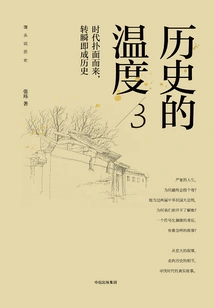
The Temperature of History 3: the Times Are Coming, and History is Made in a Blink of an Eye
by Zhang Wei
About This Novel
Why did Ye Mingchen, who insisted on his integrity and called himself "Su Wu of the Sea", end up with "eternal infamy"? Why did Yan Fu's life finally take a turn? Did Leonardo da Vinci really travel back in time from modern times? Churchill, who won the Nobel Prize for Literature, what kind of other side did he have? Ye Mingchen, Ding Ruchang, Shen Xin, Zhang Zuolin, Li Yuanhong, Yan Fu, Rabe, Churchill, Leonardo da Vinci, Guevara... What kind of life is behind these names that may be familiar or unfamiliar? What kind of era do their stories reflect? In Zhang Wei's abstract description, every name and event in the history books can present a vivid and vivid picture, changing history in its own way, or being changed by history. History is no longer just cold years and numbers, but stories with warmth and real people of flesh and blood. The author uses a dialectical vision as much as possible to restore those historical events and historical figures, so that the seemingly boring history can show its true warmth with its flesh and blood, its hesitation, its flash, and its belief.
Official Sources
What Readers Think
Rating
Community(0)
Official(3)Scraped 2mo ago
History cannot be assumed
This book is divided into two different styles. The first and middle chapters are about the Qing Dynasty and the Anti-Japanese War period, while the second chapter is much lighter and covers various celebrities and inventions. It took me 234 minutes to read this book, which to be honest is not that fast. The main reason is that the history after 1840 is really heartbreaking and depressing, so I couldn't help but put it down and change my mind after reading a few articles. When I was studying, I disliked modern history the most. It opened up about the humiliating defeat and peace, the cession of territory and compensation, from 22 million taels of silver to 400 million silver, from the Treaty of Nanjing to the Treaty of Shimonoseki. At that time, the Qing Dynasty was like a defenseless girl with a huge fortune, wanting to take a bite of everything. I also don't like the theme of the Anti-Japanese War. When I was in school, I hated DS the most. When and where was the meeting held, what was its significance, and what was determined... I gritted my teeth when I recited it. I hated Chiang for being cowardly when I saw the war situation, and I was angry with Zhang Xueliang for his incompetence... As I grow older, I understand everything behind it. Who can blame me? The system of the Qing Dynasty has not adapted to the new era, and the short-sightedness of those in power has added fuel to the flames. Even ministers like Zeng Guofan, Li Hongzhang, Zuo Zongtang, and Zhang Zhidong could not solve the problem of the collapse of the building. Their personal efforts were in vain in the face of the times, and they only partially delayed the collapse of the Qing Dynasty. During the Anti-Japanese War, Chiang Kai-shek was also very helpless. Externally, Europe and the United States and the Soviet Union pretended to be deaf and dumb, turning a blind eye to China's request for help, and turned a deaf ear to Japan's heinous crimes. Internally, the warlords were not fuel-efficient lamps, and they were all making their own small calculations. On the surface, they were hahaha, but on the inside, they were mmp. Except for Chiang's direct descendants, who really paid attention to him? Finally, I suddenly understood the history of the party. The main reason for China's victory was the firm ideological belief in victory and the firm support for Mao at that time. Ideologically, the Kuomintang felt that it would lose many times. Without the belief that it would win, it was difficult to have the confidence to defeat, which would inevitably lead to military chaos and mistakes. Failure to provide unreserved support to Chiang will inevitably lead to a group of scattered sands calling for themselves, and they will fly away when disaster strikes. So what now? War is an examination room for testing national strength. I hope that the people of the country will be self-reliant and that the leaders will be calm and open-minded, not lose themselves in the applause, and be firm and down-to-earth.
Look at modern issues from a historical perspective
The book written by the steamed bun master must be supported.
Rating
Community(0)
Official(3)Scraped 2mo ago
History cannot be assumed
This book is divided into two different styles. The first and middle chapters are about the Qing Dynasty and the Anti-Japanese War period, while the second chapter is much lighter and covers various celebrities and inventions. It took me 234 minutes to read this book, which to be honest is not that fast. The main reason is that the history after 1840 is really heartbreaking and depressing, so I couldn't help but put it down and change my mind after reading a few articles. When I was studying, I disliked modern history the most. It opened up about the humiliating defeat and peace, the cession of territory and compensation, from 22 million taels of silver to 400 million silver, from the Treaty of Nanjing to the Treaty of Shimonoseki. At that time, the Qing Dynasty was like a defenseless girl with a huge fortune, wanting to take a bite of everything. I also don't like the theme of the Anti-Japanese War. When I was in school, I hated DS the most. When and where was the meeting held, what was its significance, and what was determined... I gritted my teeth when I recited it. I hated Chiang for being cowardly when I saw the war situation, and I was angry with Zhang Xueliang for his incompetence... As I grow older, I understand everything behind it. Who can blame me? The system of the Qing Dynasty has not adapted to the new era, and the short-sightedness of those in power has added fuel to the flames. Even ministers like Zeng Guofan, Li Hongzhang, Zuo Zongtang, and Zhang Zhidong could not solve the problem of the collapse of the building. Their personal efforts were in vain in the face of the times, and they only partially delayed the collapse of the Qing Dynasty. During the Anti-Japanese War, Chiang Kai-shek was also very helpless. Externally, Europe and the United States and the Soviet Union pretended to be deaf and dumb, turning a blind eye to China's request for help, and turned a deaf ear to Japan's heinous crimes. Internally, the warlords were not fuel-efficient lamps, and they were all making their own small calculations. On the surface, they were hahaha, but on the inside, they were mmp. Except for Chiang's direct descendants, who really paid attention to him? Finally, I suddenly understood the history of the party. The main reason for China's victory was the firm ideological belief in victory and the firm support for Mao at that time. Ideologically, the Kuomintang felt that it would lose many times. Without the belief that it would win, it was difficult to have the confidence to defeat, which would inevitably lead to military chaos and mistakes. Failure to provide unreserved support to Chiang will inevitably lead to a group of scattered sands calling for themselves, and they will fly away when disaster strikes. So what now? War is an examination room for testing national strength. I hope that the people of the country will be self-reliant and that the leaders will be calm and open-minded, not lose themselves in the applause, and be firm and down-to-earth.
Look at modern issues from a historical perspective
The book written by the steamed bun master must be supported.