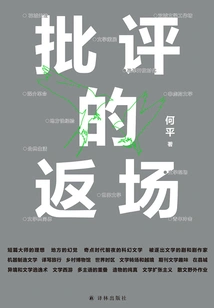
Return of Criticism
by He Ping
About This Novel
He Ping is not an academic critic in the usual sense. In the past five or six years, he has hosted the "Flower City Concern" column, convened the "Shanghai-Nanjing Twin Cities Literary Workshop", and edited the "On-site Literature Series" and the "Literary Community Book Series" to realistically influence the current literary production and ecology in order to fulfill his critical ideal of rebuilding the dialogue and publicity of literary criticism. "The Return of Criticism" is based on the long-term literary history and the integrity of the macro-literary view. It uses field surveys to explore and redraw the panoramic map of contemporary Chinese literature. It is a native archive of the literary scene. Not only that, in He Ping's view, it is an important tradition of modern Chinese literary criticism that critics take root in the literary scene and participate in literary production and the construction of literary history. Adhering to this tradition, "The Return of Criticism" presents a unique personal critical style in its concepts, postures, practices, paradigms and styles. The book is divided into three volumes: "Ideology", "Writers" and "Scene". "Trend of Thought" is He Ping's exploration and reflection on Chinese literature as a whole in the era of reform and opening up, especially the 20 years of the new century; "Writer" is a series of case studies of writers, in which he reflects on the aesthetic creation of contemporary Chinese writers using five writers, including Alai, Chi Zijian, Li Er, Ai Wei, and Qiu Huadong; "Site" is a private literary archive that contains the general comments of thirty issues of the "Flower City Concern" column hosted by the author from 2017 to 2021. He Ping uses a critic's aesthetic sensitivity and independent judgment to sort out and identify the rich literary scene, extract new literary trends and aesthetic experiences, and pay attention to the era of reform and opening up, especially important literary issues in the new century: local and world literature, media revolution, the impact of AI technology on literature, literary generations and youth writing, reform The historical logic of Chinese literature in the era of reform and opening up, multi-ethnic literature and literary communities, emerging literary styles, social changes, etc., Starting from the literary issues of the times, realize the return of literary criticism to contemporary Chinese literature and the reality of China it is related to, demonstrating the effectiveness and reality of literary criticism with attitude, temperature, and emotion.
Official Sources
What Readers Think
Rating
Community(0)
Rating
Community(0)
