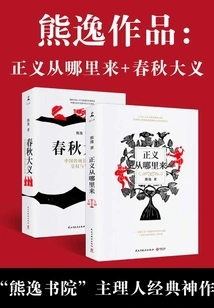
Xiong Yi: Spiritual Journey on Paper (spring and Autumn Days + Where Justice Comes From)
by Xiong Yi
About This Novel
Obtained a collection of works by the director of "Xiong Yi Academy", a total of two volumes. "Where Does Justice Come From": Greed, violence, corruption... Who has stolen our justice? From wars and social disputes to interpersonal disputes and ethical issues, this is a world full of contradictions. Therefore, from ancient times to the present, people are so thirsty for justice, and issues related to justice have always deeply troubled the most outstanding intellectuals. However, from the Hundred Schools of Thought in ancient China to utilitarianism, liberalism, and communitarianism in the Western world, the concept of justice has always been chaotic and vague. Xiong Yi focused on the topic of justice and elaborated on it from different aspects in chapters: happiness or justice, what is justice, the dilemma of free will, the dilemma of original sin, Kant's mistakes, great jealousy... With careful thinking, he integrated the relevant thoughts of representative philosophers from ancient and modern times at home and abroad, such as Chinese Confucianism, Taoism, Mohists, as well as Socrates, Plato, Aristotle, Montaigne, Spinoza, Rousseau, Adam Smith, Russell, Kant, Hayek, Fromm, Rawls, etc. In the West; and listed a large number of historical cases and literary classics to explore in depth what justice is, where it originates and how to realize justice. This heart-stirring work uses popular, vivid and even literary language to take us into a carefully laid out intellectual labyrinth. In the process of dialogue with sages, we can gain the pleasure of speculation and the enlightenment of wisdom. "Spring and Autumn Days: Imperial Power and Academics in the Traditional Chinese Context": "Spring and Autumn" has long been revered as the supreme holy book of political philosophy in ancient China, and is considered to be the only Confucian classic compiled by Confucius himself. However, the "Spring and Autumn Annals" uses subtle words and great meanings to hide praise and criticism, which is very difficult to understand, especially as it has become more and more complicated after interpretations by classics scholars of the past dynasties. So how did "Spring and Autumn" and related classics play a practical role in an authoritarian society for two thousand years, and even influence the wind and rain? What kind of existence is the Spring and Autumn Period, which has always been regarded as the Chinese spirit? Xiong Yi starts from a murder case in the Tang Dynasty. Through a large number of vivid historical cases, using detailed textual research and meticulous logic, he reveals layer by layer how Chinese classic culture dating back to the Spring and Autumn Period, including "Spring and Autumn", "One Classic and Three Transmissions", "The Analects" and "Laozi", were distorted into tools of power under imperial politics. Xiong Yi plucked thousands of years of historical facts and classics at his fingertips, and allowed emperors, sages, dignitaries, generals, scribes and other people from different eras to have conversations across the air. When readers are immersed in his written world, a clue that stretches for more than two thousand years gradually emerges.
Official Sources
What Readers Think
Rating
Community(0)
Rating
Community(0)