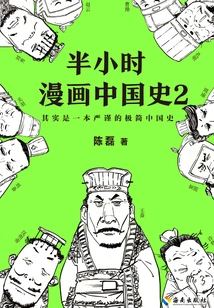
Half-hour Comic History of China 2
by Bastard
About This Novel
Read comics for half an hour and learn about 5,000 years of history. Use comics to interpret history and start a new reading trend! "Half-Hour Comic History of China 2" is the second part of the "Half-Hour Comic History of China" series. The climax of the Han Dynasty, the Three Kingdoms era where heroes competed for power, and the unrestrained style of the Wei and Jin Dynasties all shine in this book! "Half-hour Comic History of China 2" is actually a rigorous and minimalist history of China! The author has been highly recommended by Zhang Quanling, former CCTV host and mentor of the popular online TV series "Qi Pa Shuo"! Read comics for half an hour and learn about five thousand years of history. Use comics to interpret history and start a new reading trend. Just through hand-drawings and jokes, Erhuizi has drawn out a clear historical context: the Spring and Autumn Period and the Warring States Period are like a class, the Great Qin Dynasty is like a class, the Great Qin Dynasty is just too addictive, the Three Kingdoms have three major battles, the Wei and Jin Dynasties are full of weird things, the Southern and Northern Dynasties are rich in prodigal sons, the Tang Dynasty has a cool national style... Uncovering the complicated historical surface, omitting the insignificant details, every page There are historical jokes that will make you laugh every three seconds, while the emperors and generals hand-drawn by the idiots are cheap and silly: Emperor Qin, Emperor Wu of Han, Emperor Zong of Tang, Emperor Song, Cao Cao, and Sun Quan are all just like you and me, with strengths and weaknesses, friends and enemies, and their amazing energy bursting out at key points in history has created three thousand years of wonderful Chinese history. And while you are laughing out your abs, you have unknowingly understood the history.
Official Sources
What Readers Think
Rating
Community(0)
Official(96)Scraped 2mo ago
Buying a physical book is probably about the same as reading two chapters. price
The author must be crazy about money...
The wait is finally here! ! !
I was the first to follow it on WeChat. Not only are the paintings beautiful, but they also have a deep memory. Those who want to learn some history easily, hurry up and read it! ! ! Recommend! ! !
Expensive. . . . . .
I like this book very much. I wonder if you will like it?
The book is okay, but too expensive
The content is good, lively and interesting, but it's too expensive. I was originally planning to buy three chapters to read, but, my God, this is a bundled sale. I had to buy it all at once. I'm speechless.
crazy
I'm crazy about money. It's so expensive.
The author is as talented as Wang Mang and relatively rational.
Very good, a model for writing history books for the next generation.
[So-called Chinese History]
?0?21. Things in the world alternate between division and union. If division lasts for a long time, it will unite. If unity lasts for a long time, it will divide. Xia was unified, followed by Shang and Zhou, and the Spring and Autumn Period and Warring States were in chaos; Qin was unified, and the Han Dynasty was succeeded, and the Three Kingdoms, Wei, Jin, Southern and Northern Dynasties were in chaos; The Sui Dynasty unified, the Tang Dynasty succeeded, the Five Dynasties and Ten Kingdoms, the Song, Liao and Jin Dynasties were in chaos; the Yuan Dynasty was unified, the Ming and Qing Dynasties were succeeded, and the Republic of China was in chaos. 2. Beauty is a disaster and can overwhelm a country or a city. The Xia Dynasty died from Meixi; the Shang Dynasty died from Daji; the Western Zhou Dynasty died from Baosi; Wu died from Xishi; Qin Dynasty was won by Lu Yi and Zhao Ji; Jin Niu succeeded Ma, with the power of Guang Ji; Tang Dynasty declined by Yang Yuhuan; Ming Dynasty died by Chen Yuanyuan; Qing Dynasty was defeated by Empress Dowager Cixi. 3. There are countless choices in history, and the choice is in the hands of someone Li Si of the Qin Dynasty helped Zhou to persecute the emperor and burned books to harass the Confucians; Wang Mang of the Han Dynasty was a mess of scholars who governed the country; Anlu Mountain in the Tang Dynasty, the Anshi Rebellion, turned from prosperity to decline; King Anshi of the Song Dynasty, reformed and reformed, turned from governance to chaos; Wu Sangui in the Ming Dynasty was selfish and led wolves into the house; Yuan Shikai in the Qing Dynasty betrayed his friends for glory and was capricious. 4. Internal worries include villains intervening in politics, such as relatives, eunuchs, and harems; internal worries include corruption in the officialdom, and official pressure will inevitably lead to rebellion by the people; external worries include ethnic conflicts, and foreigners are watching and delaying them. The demise of all dynasties was caused by these three factors. 5. The winner is a prince and the loser is a thief. History is like this: false statements that praise the winner and add insult to injury to the loser. The winner is Liu Bang, the loser is Xiang Yu; the winner is Li Shimin, the loser is Dou Jiande; Victory is Zhu Yuanzhang, defeat is Zhang Shicheng; victory is the king of a country, defeat is thieves and bandits. 6. Overcorrection is always too much, but in fact, too much is not enough. The Qin Dynasty respected Fa, and the Han Dynasty respected Confucianism; The Tang Dynasty emphasized martial arts over literature, while the Song Dynasty emphasized literature over martial arts; Poetry was popular in the Tang and Song Dynasties, and eight-legged poetry was popular during the Ming and Qing Dynasties. 7. The more fragmented and politically chaotic the country becomes, the more brilliant its ideas will be. The greater the unification and political stability, the more stagnant the thinking becomes. The former is like the contention of a hundred schools of thought in the Spring and Autumn Period and the Warring States Period, and the fusion of the three religions in the Wei, Jin, Southern and Northern Dynasties; The latter is like the burning of books and the entrapment of Confucianism in the Qin Dynasty, the sole respect of Confucianism in the Han Dynasty, the eight-part essay in the Ming Dynasty, and the literary prison of the Qing Dynasty. 8. Regional environment affects destiny Since ancient times, China has been bordered by the Pacific Ocean to the east, desolate and inhabited Siberia to the north, the Taklimakan Desert to the northwest, and the Himalayas to the southwest. Living in such a closed environment has developed the Chinese people's farming character of being reserved, conservative, moderate, and passive. Therefore, the governments of all previous dynasties emphasized agriculture and suppressed commerce, emphasizing ethics and literary talent over practical science and technology; For example, the Xia regime was in Shaanxi and the Shang regime was in Henan; the Western Zhou regime was in Shaanxi and the Eastern Zhou regime was in Henan; The political power of Qin and Western Han Dynasty was in Shaanxi, and the political power of Eastern Han Dynasty was in Henan; The political power of the Sui and Tang Dynasties was in Shaanxi, and the political power of the Northern Song Dynasty was in Henan. Five thousand years of civilization and four thousand years of history have all been staged in the Central Plains region, where agriculture is the most developed. It can be seen that China has always been a yellow civilization based on agriculture. It was not until the foreign Mongols invaded the Central Plains and established their capital in Beijing that the Ming and Qing regimes were located here, and China's agricultural status was gradually shaken. When the political power confronts the East and the West, the West is strong and the East is weak; when the North and the South confront each other, the North is strong and the South is weak. The reason is precisely that the west and north are closer to nomadic peoples, and the blending of the two cultures is naturally more powerful than the simple farming culture of the southeast. However, every time foreign tribes invaded by force, they were quickly assimilated by Han culture. 9. At the beginning of a dynasty, the king is strong and his ministers are strong; during the dynasty, the king is strong and his ministers are weak; at the end of the dynasty, the king is weak and his ministers are strong. For example, in the early Tang Dynasty, the emperor had Taizong, and his ministers had Fang and Du; in the Tang Dynasty, the emperor had Xuanzong, and his ministers were Li Linfu, Yang Guozhong and others; At the end of the Tang Dynasty, the kings were insignificant, but their ministers were like tigers and wolves, like Zhu Wen. This has always been the case in all dynasties, how could he be like this! 10. Governance by force alone is hard and easy to break; governance by civility alone can be bullied by the weak; only by combining civil and military force to achieve both strength and softness can long-term peace and stability be achieved. Just like the Qin and Yuan Dynasties, which were invincible but quickly annihilated, the two Song Dynasties had a prosperous culture, but were repeatedly bullied by foreigners. Only the Han and Tang Dynasties focused on literature, Taoism and military strategy, which lasted for three to four hundred years and were known as prosperous times. This is no longer the case.
The author must be crazy about money. It's so expensive.
The author must be crazy about money. It's so expensive.
A bit interesting
Overall very good. To say that there are shortcomings, it should be that the textual description of individual links is not in place. Some other views are too biased.
Rating
Community(0)
Official(96)Scraped 2mo ago
Buying a physical book is probably about the same as reading two chapters. price
The author must be crazy about money...
The wait is finally here! ! !
I was the first to follow it on WeChat. Not only are the paintings beautiful, but they also have a deep memory. Those who want to learn some history easily, hurry up and read it! ! ! Recommend! ! !
Expensive. . . . . .
I like this book very much. I wonder if you will like it?
The book is okay, but too expensive
The content is good, lively and interesting, but it's too expensive. I was originally planning to buy three chapters to read, but, my God, this is a bundled sale. I had to buy it all at once. I'm speechless.
crazy
I'm crazy about money. It's so expensive.
The author is as talented as Wang Mang and relatively rational.
Very good, a model for writing history books for the next generation.
[So-called Chinese History]
?0?21. Things in the world alternate between division and union. If division lasts for a long time, it will unite. If unity lasts for a long time, it will divide. Xia was unified, followed by Shang and Zhou, and the Spring and Autumn Period and Warring States were in chaos; Qin was unified, and the Han Dynasty was succeeded, and the Three Kingdoms, Wei, Jin, Southern and Northern Dynasties were in chaos; The Sui Dynasty unified, the Tang Dynasty succeeded, the Five Dynasties and Ten Kingdoms, the Song, Liao and Jin Dynasties were in chaos; the Yuan Dynasty was unified, the Ming and Qing Dynasties were succeeded, and the Republic of China was in chaos. 2. Beauty is a disaster and can overwhelm a country or a city. The Xia Dynasty died from Meixi; the Shang Dynasty died from Daji; the Western Zhou Dynasty died from Baosi; Wu died from Xishi; Qin Dynasty was won by Lu Yi and Zhao Ji; Jin Niu succeeded Ma, with the power of Guang Ji; Tang Dynasty declined by Yang Yuhuan; Ming Dynasty died by Chen Yuanyuan; Qing Dynasty was defeated by Empress Dowager Cixi. 3. There are countless choices in history, and the choice is in the hands of someone Li Si of the Qin Dynasty helped Zhou to persecute the emperor and burned books to harass the Confucians; Wang Mang of the Han Dynasty was a mess of scholars who governed the country; Anlu Mountain in the Tang Dynasty, the Anshi Rebellion, turned from prosperity to decline; King Anshi of the Song Dynasty, reformed and reformed, turned from governance to chaos; Wu Sangui in the Ming Dynasty was selfish and led wolves into the house; Yuan Shikai in the Qing Dynasty betrayed his friends for glory and was capricious. 4. Internal worries include villains intervening in politics, such as relatives, eunuchs, and harems; internal worries include corruption in the officialdom, and official pressure will inevitably lead to rebellion by the people; external worries include ethnic conflicts, and foreigners are watching and delaying them. The demise of all dynasties was caused by these three factors. 5. The winner is a prince and the loser is a thief. History is like this: false statements that praise the winner and add insult to injury to the loser. The winner is Liu Bang, the loser is Xiang Yu; the winner is Li Shimin, the loser is Dou Jiande; Victory is Zhu Yuanzhang, defeat is Zhang Shicheng; victory is the king of a country, defeat is thieves and bandits. 6. Overcorrection is always too much, but in fact, too much is not enough. The Qin Dynasty respected Fa, and the Han Dynasty respected Confucianism; The Tang Dynasty emphasized martial arts over literature, while the Song Dynasty emphasized literature over martial arts; Poetry was popular in the Tang and Song Dynasties, and eight-legged poetry was popular during the Ming and Qing Dynasties. 7. The more fragmented and politically chaotic the country becomes, the more brilliant its ideas will be. The greater the unification and political stability, the more stagnant the thinking becomes. The former is like the contention of a hundred schools of thought in the Spring and Autumn Period and the Warring States Period, and the fusion of the three religions in the Wei, Jin, Southern and Northern Dynasties; The latter is like the burning of books and the entrapment of Confucianism in the Qin Dynasty, the sole respect of Confucianism in the Han Dynasty, the eight-part essay in the Ming Dynasty, and the literary prison of the Qing Dynasty. 8. Regional environment affects destiny Since ancient times, China has been bordered by the Pacific Ocean to the east, desolate and inhabited Siberia to the north, the Taklimakan Desert to the northwest, and the Himalayas to the southwest. Living in such a closed environment has developed the Chinese people's farming character of being reserved, conservative, moderate, and passive. Therefore, the governments of all previous dynasties emphasized agriculture and suppressed commerce, emphasizing ethics and literary talent over practical science and technology; For example, the Xia regime was in Shaanxi and the Shang regime was in Henan; the Western Zhou regime was in Shaanxi and the Eastern Zhou regime was in Henan; The political power of Qin and Western Han Dynasty was in Shaanxi, and the political power of Eastern Han Dynasty was in Henan; The political power of the Sui and Tang Dynasties was in Shaanxi, and the political power of the Northern Song Dynasty was in Henan. Five thousand years of civilization and four thousand years of history have all been staged in the Central Plains region, where agriculture is the most developed. It can be seen that China has always been a yellow civilization based on agriculture. It was not until the foreign Mongols invaded the Central Plains and established their capital in Beijing that the Ming and Qing regimes were located here, and China's agricultural status was gradually shaken. When the political power confronts the East and the West, the West is strong and the East is weak; when the North and the South confront each other, the North is strong and the South is weak. The reason is precisely that the west and north are closer to nomadic peoples, and the blending of the two cultures is naturally more powerful than the simple farming culture of the southeast. However, every time foreign tribes invaded by force, they were quickly assimilated by Han culture. 9. At the beginning of a dynasty, the king is strong and his ministers are strong; during the dynasty, the king is strong and his ministers are weak; at the end of the dynasty, the king is weak and his ministers are strong. For example, in the early Tang Dynasty, the emperor had Taizong, and his ministers had Fang and Du; in the Tang Dynasty, the emperor had Xuanzong, and his ministers were Li Linfu, Yang Guozhong and others; At the end of the Tang Dynasty, the kings were insignificant, but their ministers were like tigers and wolves, like Zhu Wen. This has always been the case in all dynasties, how could he be like this! 10. Governance by force alone is hard and easy to break; governance by civility alone can be bullied by the weak; only by combining civil and military force to achieve both strength and softness can long-term peace and stability be achieved. Just like the Qin and Yuan Dynasties, which were invincible but quickly annihilated, the two Song Dynasties had a prosperous culture, but were repeatedly bullied by foreigners. Only the Han and Tang Dynasties focused on literature, Taoism and military strategy, which lasted for three to four hundred years and were known as prosperous times. This is no longer the case.
The author must be crazy about money. It's so expensive.
The author must be crazy about money. It's so expensive.
A bit interesting
Overall very good. To say that there are shortcomings, it should be that the textual description of individual links is not in place. Some other views are too biased.
