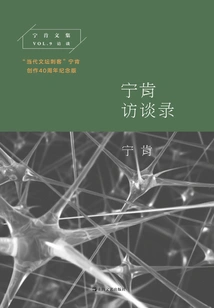
Interviews with Ning Ken (collected Works of Ning Ken)
by Rather
About This Novel
"Interviews with Ningken" is an important part of the "Collected Works of Ningken". It is mainly presented in interviews and speeches. It provides insight into Ningken's creative path and his spiritual empire, which is enough to enrich readers' understanding of Ningken, the "assassin" of contemporary literature. Ning Ken is not only a seeker of literature, but also shows his vigorous and vigorous narrative desire ideologically. His exploration of politics, literature and human nature, as well as his pursuit of the spiritual world of Tibet, demonstrate his very serious thinking and unique spiritual dimension. "Interviews with Ningken" is one of the "Collected Works of Ningken", including "Interviews" and "Appendix on Creation". There are dialogues with poet Yuan Yi on "Let Life Interact with Literature", dialogue with critic Wang Chunlin on "The Charm of Novel", dialogue with critic Xu Yong on "The Turning Point of History and Literary Aesthetics", and dialogue with China Youth Daily reporter Liu Xianshu Dialogue "Questioning the Structure and Occurrence of "City of Masks"", dialogue with "Beijing Evening News" reporter Sun Xiaoning "Unrealistic Possibilities of a Realistic Subject", dialogue with "China Reading News" reporter Shu Jinyu "Writing "Exploded" by Music" , a dialogue with Wu Yashun of the Beijing News "Literature should view power from a human perspective", a dialogue with Xu Zhaozheng, a young critic with a doctorate in literature, "Love this world without miracles", and a dialogue with post-90s writer Li Tang "Using power themes to express Twenty-six articles including "The Silent Songs of Human Nature" show the life background, mental journey, educational resources, creative experience, etc. Behind Ning Ken's works. They are not only the author's candid communication with the public, but also valuable information for readers and critics to understand people and the world. These seem to be the remnants and derivatives of the work, but they are actually the greater depth of the work. Ning Ken, a Beijinger. Novelist and essayist, his main works include the novels "Heaven·Zang", "The Masked City", "Three Trios", "The Door of Silence" and "The Crater". Born in Beijing in 1959, his original name was Ning Minqing and his ancestral home was Ningzhuang, Hejian County, Hebei Province. Graduated from the Chinese Department of the Second Branch of Beijing Normal University in 1983. In 1982, he published his debut poem "Snow Dream" at "Grudge" in Shanghai. He lived in Tibet from 1984 to 1986 and wrote a series of prose works such as "Sky Lake", "Tibetan Song" and "The Silent Shore", making him one of the representatives of China's "new prose" movement. He is the author of essay collections "Speak, Tibet", "Beijing: City and Years", "My 20th Century" and "The Pipe of Thought". There are also short and medium story collections "Words and Objects" and "Vigram", and the non-fiction work "Notes on Zhongguancun". He is currently a member of the 9th National Committee of the Chinese Writers Association and the executive deputy editor-in-chief of "October" magazine. He has won the Lao She Literary Award for Novel twice, the first Shi Naian Literary Award, the 4th "People's Literature" Biennial Novel Award, the Beijing Literary Art Award, the overall champion of the 2nd "Contemporary" Literary Rally in 2001, the first Sun Li Prose Award Biennial Award, the first Hong Kong "Dream of Red Mansions Award" recommendation award, and the first American Newman Literary Award nomination. Selected as one of the top ten novels of Asia Weekly in 2014 and one of the best Chinese books in 2017, with works translated into English, French, Italian, and Czech.
Official Sources
What Readers Think
Rating
Community(0)
Rating
Community(0)