Historical Records (twelve Volumes in Total)
by H
About This Novel
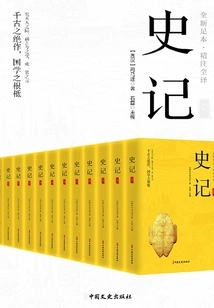
The entire text is fully translated, the text is compared with the white text, and the reading is barrier-free! The whole book adopts a structural system of original text and vernacular annotations. The annotations are vivid and accurate, and the original flavor is delicate, clearing away reading obstacles for readers. The vernacular translation is faithful to the original meaning, popular and fluent; rare and difficult words are added with phonetic notations and explanations, which has high reading value! The whole book has twelve volumes in total, bringing together well-known experts and scholars, newly arranged and divided into sections, presenting the whole book to the maximum extent, focusing on the essence; the chronicles, ten lists, eight books, aristocratic families, biographies, the original version, complete without deletions! The original text refers to various popular versions and collation works of "Historical Records"! The newly added "Report to Ren An" is more comprehensive than previous editions of historical records, allowing readers to understand Sima Qian's ideas and ideas more comprehensively and accurately! "Historical Records", one of the Twenty-Four Histories, was originally called "Tai Shi Gong Shu" or "Tai Shi Gong Ji" or "Tai Shi Ji". It is a biographical history book written by Sima Qian, a historian of the Western Han Dynasty. It is the first biographical general history in Chinese history. It records a history of more than 3,000 years from the legendary Yellow Emperor era to the fourth year of Emperor Taichu of Han Dynasty. In the first year of Taichu (104 BC), Sima Qian began the creation of "Tai Shi Gong Shu", which was later called "Historical Records". This work took 14 years to complete. The "Historical Records" has a total of 130 chapters, including twelve chronicles (recording the achievements of the emperors of the past dynasties), thirty families (recording the rise and fall of the vassal states and Han Dynasty princes, nobles), seventy biographies (recording the words and deeds of important figures, mainly describing people and ministers, the last chapter of which is a self-preface), ten tables (chronology of major events), and eight books (recording various laws and regulations, etiquette, music, music, calendar, astronomy, Zen, water conservancy, and finance). It is all-encompassing and comprehensive, with a clear context and a detailed record of the development of politics, economy, military, culture and other aspects in ancient times. "Historical Records" is an excellent literary work and plays an important role in the history of Chinese literature. From the perspective of historical value, it has preserved historical materials for thousands of years and has extraordinary historical value. It is listed as the "First of the Twenty-Four Histories". It pioneered the biographical recording method and was highly praised by historians and scholars of all ages. From the perspective of literary value, its descriptive language is vivid, the image is clear, the narrative is thorough, and the narrative is flexible. Liu Xiang and others believe that this book is "good at explaining things, argumentative but not flashy, and qualitative but not slangy". This edition has 131 chapters. In addition to the original 130 chapters, Sima Qian's "Book of Reporting to Ren An" is also included, so that readers can understand Sima Qian's ideas and ideas more comprehensively and accurately.
Official Sources
What Readers Think
Rating
Community(0)
Official(6)Scraped 1mo ago
Although Xia Yu is a legendary figure, he represents people's good wishes. Life is sometimes very bitter, which requires people to have good wishes.
Once upon a time, society was a matrilineal society. Later, after continuous evolution, it gradually turned into a country and established a dynasty. Many things were in line with development.
The last song of the historian, "Li Sao" without rhyme, is finally finished. Check in and check in.
What about Suo Yin Shu Zan?
Why did you delete the "Suo Yin Shu Praise" at the end of each article?
How to translate nine men into nine sons?
How to translate nine men into nine sons?
History cannot be easily forgotten. This was Sima Qian's original intention in writing historical records. History should be known to more people instead of being erased in the long river of history.
Rating
Community(0)
Official(6)Scraped 1mo ago
Although Xia Yu is a legendary figure, he represents people's good wishes. Life is sometimes very bitter, which requires people to have good wishes.
Once upon a time, society was a matrilineal society. Later, after continuous evolution, it gradually turned into a country and established a dynasty. Many things were in line with development.
The last song of the historian, "Li Sao" without rhyme, is finally finished. Check in and check in.
What about Suo Yin Shu Zan?
Why did you delete the "Suo Yin Shu Praise" at the end of each article?
How to translate nine men into nine sons?
How to translate nine men into nine sons?
History cannot be easily forgotten. This was Sima Qian's original intention in writing historical records. History should be known to more people instead of being erased in the long river of history.