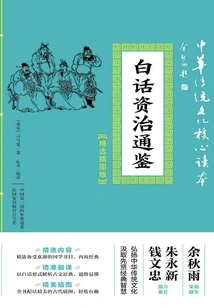
Vernacular Zizhi Tongjian
by Sima Guang
About This Novel
"Zizhi Tongjian", referred to as "Tongjian", is an unprecedented chronological general history masterpiece compiled by the famous Northern Song Dynasty historian Sima Guang and his assistants Liu Xun, Liu Shu, Fan Zuyu, Sima Kang and others over a period of 19 years. It occupies a very important position in the official history books of our country. The book depicts the historical development from the Warring States Period to the Five Dynasties, and explores the reasons for the rise and fall of the unified dynasties such as Qin, Han, Jin, Sui, and Tang, as well as the Seven Heroes of the Warring States Period, the Three Kingdoms of Wei, Shu, Wu, the Five Hus and Sixteen Kingdoms, the Northern and Southern Dynasties, and the Five Dynasties and Ten Kingdoms. It vividly depicts the emperors, generals, and ministers' way of governing the country and dealing with people, as well as their joys and sorrows of life and death in the whirlpool of history. For the convenience of reading, this book specially selects classic chapters from "Zi Zhi Tong Jian", translates them into vernacular, and rearranges them so that more modern readers can appreciate the unique charm of this work.
Official Sources
What Readers Think
Rating
Community(0)
Official(11)Scraped 2mo ago
Each article usually ends with its own comments, elevating an originally scattered superficial event to a higher theoretical level to give metaphorical advice to the ruler. This may be a true portrayal of Sima Guang, who after his career failed, was worried about his people when he was high up in the temple, and worried about his king when he was far away from the world.
The book uses chronology as its latitude and country as its latitude, and narrates the major historical events that occurred in ancient China in sequence. At the same time, it uses various writing methods such as narration and interjection to explain the life experiences of the characters and explain the causes and consequences of the events, making it easy for people to get a systematic and clear impression.
The reason why the Jin Kingdom perished. Mainly because of the new king. Foolish and ignorant. Sanctions cannot be used alone. Don't understand people's hearts. Talent but no virtue. Eventually became the target of public criticism. Rely on the power in your hands. Bullying. Finally pushed himself to destruction
...
How come there are only more than 200,000 words of vernacular writing?
Very good, very good, very good, very good
for the goal
Work silently to achieve your goals.
China's excellent traditional culture is our most profound cultural soft power and is also the cultural fertile ground for socialism with Chinese characteristics to take root. China's excellent traditional culture nourishes the national spirit of the Chinese nation, gives the Chinese nation great vitality and cohesion, and is the source of creativity for the achievements of Chinese civilization. Inheriting and developing China's excellent traditional culture and learning and mastering its various ideological essences will not only be of great help to us in establishing a correct world outlook, outlook on life, and values, but also provide useful inspiration and guidance for us to deal with various social affairs.
The quality is very good and the article is easy to understand.
The descriptions of typical characters and important times allowed me to understand the general outline of this large period of history. The Chinese people have come through such continuous suffering, and nothing can wipe us out. The only thing humans learn from history is that humans never learn from true history.
for the goal
Working silently to achieve his goals.
Rating
Community(0)
Official(11)Scraped 2mo ago
Each article usually ends with its own comments, elevating an originally scattered superficial event to a higher theoretical level to give metaphorical advice to the ruler. This may be a true portrayal of Sima Guang, who after his career failed, was worried about his people when he was high up in the temple, and worried about his king when he was far away from the world.
The book uses chronology as its latitude and country as its latitude, and narrates the major historical events that occurred in ancient China in sequence. At the same time, it uses various writing methods such as narration and interjection to explain the life experiences of the characters and explain the causes and consequences of the events, making it easy for people to get a systematic and clear impression.
The reason why the Jin Kingdom perished. Mainly because of the new king. Foolish and ignorant. Sanctions cannot be used alone. Don't understand people's hearts. Talent but no virtue. Eventually became the target of public criticism. Rely on the power in your hands. Bullying. Finally pushed himself to destruction
...
How come there are only more than 200,000 words of vernacular writing?
Very good, very good, very good, very good
for the goal
Work silently to achieve your goals.
China's excellent traditional culture is our most profound cultural soft power and is also the cultural fertile ground for socialism with Chinese characteristics to take root. China's excellent traditional culture nourishes the national spirit of the Chinese nation, gives the Chinese nation great vitality and cohesion, and is the source of creativity for the achievements of Chinese civilization. Inheriting and developing China's excellent traditional culture and learning and mastering its various ideological essences will not only be of great help to us in establishing a correct world outlook, outlook on life, and values, but also provide useful inspiration and guidance for us to deal with various social affairs.
The quality is very good and the article is easy to understand.
The descriptions of typical characters and important times allowed me to understand the general outline of this large period of history. The Chinese people have come through such continuous suffering, and nothing can wipe us out. The only thing humans learn from history is that humans never learn from true history.
for the goal
Working silently to achieve his goals.