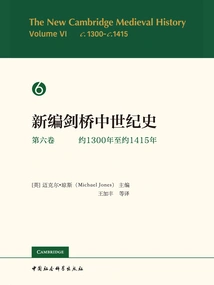
New Cambridge History of the Middle Ages (volume 6): C. 1300 to C. 1415
by (uk) Editor-in-chief Michael Jones
About This Novel
"The New Cambridge History of the Middle Ages" has a total of 7 and 8 volumes. Compared with the old version of "Cambridge History of the Middle Ages", it is clearer in writing style and chapter arrangement. It breaks through the old framework of traditional political history and attempts to present a "comprehensive history", including economic, social, spiritual, cultural and other fields within the scope of discussion, and provides a more comprehensive and detailed record of the Middle Ages. It is worth noting that the new series breaks away from the past "Eurocentrism" that regarded Europe as the whole world, and opposes the mechanical piecing together or simple summing up of the histories of European countries. It strives to examine the historical development trajectories and mutual influences of European countries in the Middle Ages as a whole, reflecting the prosperity and progress of Western academic research over the past century. This volume is the sixth volume, describing the history from 1300 to 1415 AD. Covers the 14th century, a period dominated by plague, natural disasters, and wars that ended three centuries of economic growth and cultural expansion in Christian Europe. But it was also a period that witnessed important developments in government, emphasis on and attention to changes in religious and intellectual life; it gave greater weight to the voice of the laity and to the rise of new cultural and artistic models, especially indigenous literature. Divided into four parts. The first part is an overview, discussing general topics such as the theory and practice of government, religion, social and economic history, and culture, including discussions of art, architecture, and chivalry; the second part is the national history of Western European countries; the third part discusses the papal period in Avignon and the church during the Great Schism; the fourth part discusses Eastern and Northern Europe, the Byzantine Empire, and the early Ottomans, with special attention to their social and economic relations with Western Europeans, and their relations with other civilizations in the Mediterranean.
Official Sources
What Readers Think
Rating
Community(0)
Rating
Community(0)