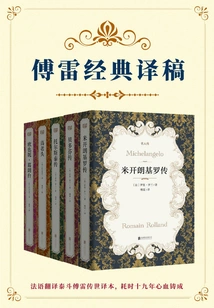
Fu Lei's Classic Translation
by (france) Romain Rolland (france) Balzac
About This Novel
Fu Lei's classic translations include five volumes: Beethoven's biography, Michelangelo's biography, Tolstoy's biography, and Goriot. "The Biography of Beethoven" Beethoven was born in an era when "breaking" and "establishing" were in conflict. He is talented and has composed one song after another that has been handed down from generation to generation; despite his ill-fated fate, he has gone through hardships and still adheres to his original intention of "being devoted to good, loving freedom more than anything else; and never betraying the truth under any circumstances." In this biography, the author not only tells the legendary life of music master Beethoven in beautiful language from different perspectives, but also reveals a great soul to readers. At the same time, Romain Rolland also compiled Beethoven's will and letters into a collection. "The Biography of Michelangelo" Michelangelo has a powerful power that can influence an era. Before him, the artistic sky in Florence was dull and lacked vitality. His appearance blew away the dark clouds hanging over it like a sudden storm. After him, Michelangelo's style influenced artists for almost three centuries. This biography mainly consists of three parts: the first part "Battle", the second part "Abandonment" and the epilogue. The author highly praises Michelangelo's artistic achievements and analyzes his inner world, thus revealing to readers a Michelangelo who is both ordinary and extraordinary, with unparalleled artistic talent and creativity. "The Biography of Tolstoy" Romain Rolland regarded Tolstoy as his spiritual mentor, and Toon's humanitarian feelings deeply moved him. Therefore, studying Toon's artistic creations, letters, and even the reminiscences of his contemporaries became the medium for Romain Rolland to express his admiration for Toon. Thus, an immortal "The Biography of Tolstoy" was born. The author's detailed research on Tolstoy has become the solid foundation of this work. With his extraordinary insight, Romain Rolland shows readers all the important aspects of the creative personality of a generation of literary giants. "Petro Goriot" In Paris in 1819, the Napoleonic era had just come to an end. Behind the prosperity of the upper class, socialites were worried about lovers and debts, nobles were weighing wealth and love, and wealthy businessmen were planning speculation and business. In a low-income apartment in the lower society, various characters are inextricably linked to the upper class: the upstart old man Gao was drained by his two daughters and died desolately in a shabby corner; the mainland young man Rastignac is determined to rise to the top and urgently needs to learn many rules of the upper class; the gangster leader Mufu Tolen is dormant in the dark, waiting for an opportunity to declare war on secular society... In "Petro Goriot", Balzac depicts the unique spirit of the times during the period of social transformation: moral decay, social tension, confusion of values, and poverty of the lower class. At the same time, society is rarely full of mobility. Human relationships and world affairs in society during the period of transformation are taking turns to be staged in this human comedy. "Eugénie Grandet" is a novel by the famous French writer Balzac. It tells the story of the innocent and beautiful Eugenie, the only daughter of the miserly and shrewd millionaire Grandet. She fell in love with her bankrupt cousin. For his sake, she did not hesitate to anger her money-loving father and spent all her private savings to help him make his way into the world. At this point, the relationship between father and daughter broke down, and the timid and virtuous mother was so frightened that she fell ill. The girl who lost her parents and her youth in the bitter expectation ended up with a heartless man who returned rich.
Official Sources
What Readers Think
Rating
Community(0)
Rating
Community(0)
