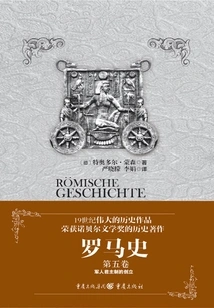
History of Rome (volume 5)
About This Novel
The fifth volume of "History of Rome" mainly involves the establishment of the military monarchy in the late Roman Republic, and studies the transformation process of Rome from a republic to a monarchy, that is, the Roman Empire. In the late Roman Republic, three military oligarchs emerged: Pompey, Caesar and Crassus. Through the conquest of Syria in eastern Asia, Rome's eastern border has expanded to Asia Minor and the Mesopotamia region, and its conqueror Pompey gained the highest honor and status; through the conquest of the Celts in northwest Gaul and the blocking of the Germans, Caesar became a famous hero; through the suppression of the slave rebellion of Spartacus, Crassus rose to fame. These three men all held heavy armies at the same time and became powerful rulers in Rome. At the same time, the former aristocratic Senate was declining day by day. Coupled with the constant fighting and strife within it, the power of the traditional aristocracy continued to decline. The Citizens' Assembly was useless except for being used by the military. Roman society was irrevocably evolving towards a dictatorial military monarchy. With this evolution, Rome's politics, economy, culture, law, etc. All experienced a series of changes. The fifth volume of "History of Rome" continues the author's inertia and cites a large number of data and original documents, as well as relevant works of ancient Roman playwrights and poets. This provides very rich materials for researchers engaged in Roman history and provides readers with a large number of reference elements. As a German, Mommsen laid a solid scientific foundation for the work with his German rational thinking and rigorous logic. It is a classic historical research work.
Official Sources
What Readers Think
Rating
Community(0)
Rating
Community(0)
