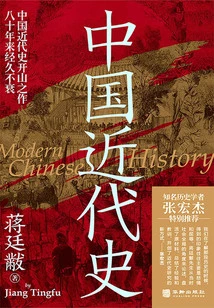
Modern History of China
by Jiang Tingfu
About This Novel
The book covers the past century from the Opium War to the eve of the Anti-Japanese War in an in-depth and simple way. It mainly explains the modern Chinese people's efforts to strengthen themselves in the face of "great changes not seen in thousands of years" and the reasons for their failure. From the Opium War to the Revolution of 1911, from the Westernization Movement to the Hundred Days Reform, from Zeng Guofan to Kang Youwei, from Li Hongzhang to Sun Yat-sen, nearly a century of historical evolution and the lives of characters are narrated. There is no boring textual research and no accumulation of historical materials, but it fully demonstrates the future of the country, the destiny of the nation and the trend of social development. The historical framework and chronological history system constructed in this book have led the trend of modern history research and are called the pioneering work of modern Chinese history research.
Official Sources
What Readers Think
Rating
Community(0)
Official(1)Scraped 1mo ago
"Modern History of China": Taking history as a mirror and reflecting on the present
"Modern History of China" by Mr. Jiang Tingfu is a classic historical work that has been deeply loved by readers since its publication. This book outlines a grand picture of China's modern history in concise and clear writing, from the smoke of the Opium War to the dawn of the Revolution of 1911, showing China's difficulties and explorations in the process of modernization. "Modern History of China" is not a long book, but its content is extremely concise. Mr. Jiang Tingfu used time as a clue to systematically sort out the major historical events in China from the mid-19th century to the early 20th century, such as the Opium War, the Taiping Rebellion, the Westernization Movement, the Sino-Japanese War of 1888, the Reform Movement of 1898, and the Revolution of 1911. He not only described the events in detail, but also deeply analyzed the causal relationship behind them, allowing readers to clearly see the development context of modern Chinese history. The most impressive thing in the book is Mr. Jiang Tingfu's profound insights. He did not simply attribute China's modern humiliation to the aggression of foreign powers, but analyzed the root causes of modern China's backwardness based on China's own history, culture and social system. He believes that the decadence of China's feudal system and its closed-door policy have caused China to lag far behind the West in the process of modernization. This perspective breaks the traditional single perspective of "aggression and counter-invasion" and provides readers with a more comprehensive and objective historical cognitive framework. The language of "Modern Chinese History" is easy to understand and the logic is clear, making it suitable for readers of all levels. Mr. Jiang Tingfu uses concise and clear words to describe complex historical events and profound historical theories, allowing readers to deeply understand the significance of modern Chinese history in the process of easy reading. The book not only contains detailed narrations of historical events, but also vivid portrayals of historical figures, such as Lin Zexu's uprightness, Zeng Guofan's profound wisdom, and Li Hongzhang's helplessness and struggle. The images of these characters vividly appear on the page, making readers feel as if they are in that changing era. This book is not only a historical work, but also a work of ideological enlightenment. Mr. Jiang Tingfu raised many questions worth pondering in the book, such as "Why is China's modernization so difficult?" And "How can China find a way out when surrounded by great powers?" These questions not only trigger readers' thinking about history, but also have important implications for China's current development. "Modern History of China" is a classic work. After years of baptism, it still has important academic value and practical significance. It is not only a must-read book for history lovers, but also an important reference book for students studying modern Chinese history. The historical wisdom and profound insights contained in the book can help readers better understand the development context of China's modern history, learn lessons from it, and enhance their confidence and sense of responsibility for national development. In short, "Modern History of China" is a classic work worth reading again and again. With concise words, profound insights and rigorous logic, it shows the full picture of China's modern history. Whether you are a reader who is interested in history or someone who hopes to draw wisdom from history, this book is a precious spiritual food.
Rating
Community(0)
Official(1)Scraped 1mo ago
"Modern History of China": Taking history as a mirror and reflecting on the present
"Modern History of China" by Mr. Jiang Tingfu is a classic historical work that has been deeply loved by readers since its publication. This book outlines a grand picture of China's modern history in concise and clear writing, from the smoke of the Opium War to the dawn of the Revolution of 1911, showing China's difficulties and explorations in the process of modernization. "Modern History of China" is not a long book, but its content is extremely concise. Mr. Jiang Tingfu used time as a clue to systematically sort out the major historical events in China from the mid-19th century to the early 20th century, such as the Opium War, the Taiping Rebellion, the Westernization Movement, the Sino-Japanese War of 1888, the Reform Movement of 1898, and the Revolution of 1911. He not only described the events in detail, but also deeply analyzed the causal relationship behind them, allowing readers to clearly see the development context of modern Chinese history. The most impressive thing in the book is Mr. Jiang Tingfu's profound insights. He did not simply attribute China's modern humiliation to the aggression of foreign powers, but analyzed the root causes of modern China's backwardness based on China's own history, culture and social system. He believes that the decadence of China's feudal system and its closed-door policy have caused China to lag far behind the West in the process of modernization. This perspective breaks the traditional single perspective of "aggression and counter-invasion" and provides readers with a more comprehensive and objective historical cognitive framework. The language of "Modern Chinese History" is easy to understand and the logic is clear, making it suitable for readers of all levels. Mr. Jiang Tingfu uses concise and clear words to describe complex historical events and profound historical theories, allowing readers to deeply understand the significance of modern Chinese history in the process of easy reading. The book not only contains detailed narrations of historical events, but also vivid portrayals of historical figures, such as Lin Zexu's uprightness, Zeng Guofan's profound wisdom, and Li Hongzhang's helplessness and struggle. The images of these characters vividly appear on the page, making readers feel as if they are in that changing era. This book is not only a historical work, but also a work of ideological enlightenment. Mr. Jiang Tingfu raised many questions worth pondering in the book, such as "Why is China's modernization so difficult?" And "How can China find a way out when surrounded by great powers?" These questions not only trigger readers' thinking about history, but also have important implications for China's current development. "Modern History of China" is a classic work. After years of baptism, it still has important academic value and practical significance. It is not only a must-read book for history lovers, but also an important reference book for students studying modern Chinese history. The historical wisdom and profound insights contained in the book can help readers better understand the development context of China's modern history, learn lessons from it, and enhance their confidence and sense of responsibility for national development. In short, "Modern History of China" is a classic work worth reading again and again. With concise words, profound insights and rigorous logic, it shows the full picture of China's modern history. Whether you are a reader who is interested in history or someone who hopes to draw wisdom from history, this book is a precious spiritual food.