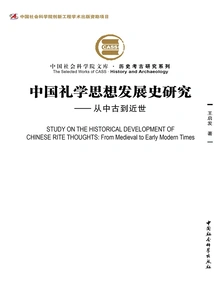
Research on the Development History of Chinese Ritual Thought: from Medieval Times to Modern Times
by Wang Qifa
About This Novel
Etiquette is both an object and a perspective; it is both a scope and a field. In the historical development process of ritual studies, in the writings of ritual scholars, it has presented a variety of academic forms and academic demands of explanation and argumentation. Its connection with various ideological expressions also has different presentations. This can be seen in the case studies and discussions in this book. This book selects some important ritual figures from the Wei, Jin, Southern and Northern Dynasties to the Song and Ming dynasties, and examines and discusses them in eight chapters, either collectively or separately. The first chapter is the study of Wang Su, Xiong Ansheng and Huang Kan's "Book of Rites" studies, as well as Kong Yingda's quotations and comments on their theories in the Tang Dynasty, including the evaluation of later scholars, etc., Which becomes the content of the first chapter. Then the era jumped to the Song Dynasty, that is, the etiquette thoughts of Li Gou, Wang Anshi, Cheng Hao, Cheng Yi, and Zhu Xi became the discussion content of Chapters 2 to 5 respectively. Among them, the political ideals, reform practices, and metaphysical theoretical constructions carried by etiquette, as well as the reconstruction of the etiquette text system and the emphasis on family rituals, can be said to be the embodiment of the academic and profound thinking of the representatives of etiquette in the two Song Dynasties. Wu Cheng, Fang Xiaoru, and Huang Daozhou are representatives of etiquette writings and ideological expressions in the Yuan and Ming Dynasties. Their writings and academic thoughts are expressed in different forms. The last three chapters of this book select their distinctive etiquette chapters for investigation and analysis to present their different styles of etiquette thought.
Official Sources
What Readers Think
Rating
Community(0)
Rating
Community(0)