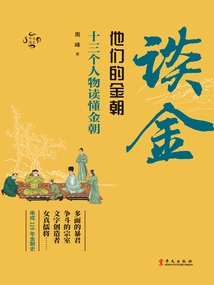
Talking About Jin: Their Jin Dynasty
by Zhou Feng
About This Novel
The Jin Dynasty established by the Jurchens seemed a bit "lonely" compared to the Song Dynasty and the mysterious Xixia Dynasty, which had numerous celebrities, and its true identity was even blurred in word of mouth among the people. As a dynasty that ruled the Central Plains for more than a hundred years, the Jin Dynasty had its own characteristics in terms of politics, economy, culture, and people's livelihood. This book selects thirteen people of the Jin Dynasty, including emperors, clan members, literati, generals, and grassroots representatives of the four strata of society: scholars, farmers, workers, and merchants. It aims to help readers understand the political, economic, cultural, and people's livelihood characteristics of the Jin Dynasty through the typical lives of typical characters, so as to gain a deeper understanding of the Song, Liao, Jin, and Xixia eras where heroes competed for power. Once you understand these characters, you can truly understand the Jin Dynasty.
Official Sources
What Readers Think
Rating
Community(0)
Official(1)Scraped 1mo ago
good
The writing style of this book is unique and clear, and it aims to construct the social landscape and governance of the Jin Dynasty through narrative descriptions of typical figures of different classes in different periods of the Jin Dynasty for more than a hundred years. There are very few books on the Jin, Liao, Xixia, Nanzhao, Tubo, Bohai... These minority regimes, but they always seem to produce excellent works... I hope academic scholars can compile more popular and rigorous history books.
Rating
Community(0)
Official(1)Scraped 1mo ago
good
The writing style of this book is unique and clear, and it aims to construct the social landscape and governance of the Jin Dynasty through narrative descriptions of typical figures of different classes in different periods of the Jin Dynasty for more than a hundred years. There are very few books on the Jin, Liao, Xixia, Nanzhao, Tubo, Bohai... These minority regimes, but they always seem to produce excellent works... I hope academic scholars can compile more popular and rigorous history books.
