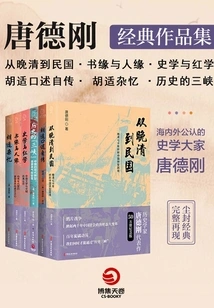
The Pioneer of Oral History: Collection of Tang Degang's Classic Works 2 (6 Volumes in Total)
by Tang Degang
About This Novel
This set of books is a collection of classic works by Tang Degang, a recognized historian at home and abroad, including six works: "From the Late Qing Dynasty to the Republic of China", "Book Connection and Popularity", "History and Red Studies", "Miscellaneous Memories of Hu Shi" and "The Three Gorges of History". The content involves many historical events and figures in the modern history of China. It has rich historical materials, free and easy writing style, and rare subject matter. It is extremely precious. It is an indispensable classic for understanding the modern history of China. "From the Late Qing Dynasty to the Republic of China": The twists and turns of the Three Gorges of the Yangtze River are the pride of the Chinese people and a trendy area in China's natural history. The Opium War opened the prelude to China's once-in-two-thousand-year "social and cultural transformation" phenomenon that began in the 19th century. In the wise eyes of historian Tang Degang, the "humanistic view of history" is just like the "natural history view." A war in 1840 not only set off a major change in China's social and political form, but also made the long history of history have to go through a hundred years of treacherous turbulence before it can enter the magnificent Pacific Ocean through the Three Gorges. Tang Degang combines the historical perspective of the Three Gorges and humanistic exploration in this book, creating an objective and in-depth history of modern China. "Books and People": Oral history is a career that Tang Degang has devoted most of his life to. After helping many modern and contemporary celebrities complete their oral autobiographies or memoirs, he also became friends with them. This book is a collection of Tang Degang's articles about his interactions with many celebrities over the years, as well as his daily reading reviews, including Gu Weijun, Zhang Xueliang, Liu Tingfang, Wu Kaixian, Liu Shaotang, Yang Zhenning and others, as well as books such as "Biographic Literature" and "Rubaiyat". Whether writing about people or commenting on books, the author pays great attention to details and intersperses many anecdotes, aphorisms, irony, and metaphors. His writing style is free and uninhibited, and his writing style is smooth. It not only shows the historical style, but also reflects the author's multi-faceted talents. "History and Redology": For most of his life, Tang Degang witnessed the frequent wars in China since modern times, and was baptized by a large number of Chinese and Western classics. While teaching and reading foreign countries, he often felt nostalgic for his homeland, so he wrote these scattered journal works in this book, which includes more than ten articles and speeches on historical theory, research methods and redology research. Tang Degang believed that excellent historical works are often excellent literary works. He advocated that "the six classics are all histories", "all histories are texts", "literature and history are not divided" and "history is transmitted through literature", which is quite insightful in order to avoid rigid and stubborn management of history. "Miscellaneous Memories of Hu Shi": This book is a memoir written by Tang Degang on many issues in Hu Shi's life, using his own memories and the records of Hu Shi's diary as materials. In addition, he also put forward his own opinions on Hu Shi's achievements in history, politics, philosophy, literature and other fields. The language of the book is majestic and the writing is full of wit and wit. It restores the true image of Hu Shi, a generation of scholars with flesh and blood, wisdom, genius and shortcomings. It is a faithful portrayal of Hu Shi's later years. "Hu Shi's Oral Autobiography": This book is compiled based on sixteen English oral recordings made by Hu Shi at the invitation of the Department of Chinese Oral History at Columbia University in the United States. Tang Degang was responsible for the interview and compiled the recording into text, covering Hu Shi's life experience and his summary and evaluation of his life's academic thoughts. Tang Degang's annotations and comments further elaborated his own views on relevant characters and events, allowing readers to understand Hu Shi and his era more clearly. Therefore, this book received high praise from overseas historians in the 1970s - "Look at De Gang first, then Hu Shi." "Historical Three Gorges": Since the Opium War in 1840, Chinese society has entered the tortuous and turbulent "Historical Three Gorges" and began a slow transformation. In this process, how many elites participated and merged into this turbulent historical tide. They waved flags and shouted, swarmed to be the first, and the waves rolled over the boat, which was inexplicably thrilling. They are loyal in words, respectful in deeds, and work quietly, slowly pushing our ancient civilization towards modernization. In this book, historian Tang Degang does not hide from relatives or respects. He analyzes the merits and demerits of these influential figures one by one without bias, showing his clear insight into the context of Chinese history and his deep concern for the fate and future of the Chinese nation.
Official Sources
What Readers Think
Rating
Community(0)
Rating
Community(0)