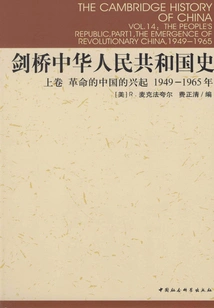
Cambridge History of the People's Republic of China (volume 1): the Rise of Revolutionary China (1949-1965)
by (u. S.) R. Macfarquhar, Edited By Fairbank Fairbank And Edited By Xie Liangsheng
About This Novel
This book is the Chinese translation of the 14th volume in the "Cambridge History of China" series. It describes the achievements and problems encountered by the People's Republic of China in its efforts to solve contemporary problems in China from 1949 to 1965. This book consists of two parts. The first part records the new regime's attempts to apply the Soviet model to China, while the second part discusses the efforts made to find a domestic development model. Both volumes analyze the key issues and developments in politics, economy, education, the party and intellectuals, and diplomacy during this period, as well as the interrelationships, interactions, and effects of the "Cultural Revolution" on all these aspects.
Official Sources
What Readers Think
Rating
Community(0)
Official(4)Scraped 1mo ago
Looking at the history of New China written by foreigners nearly forty years ago, I feel that many of the comments are still very close to the historical facts. Unfortunately, the book only touches on limited aspects of history, and the documentation is not rich enough.
Indeed, the cultural differences between the East and the West are very big, and the content described is naturally insufficient or even very little. What should the real history be like?
With the continuous development of the times, China's historical value has benefited from being fully reflected. Such expressions and methods can make people understand faster, even understand, and satisfy curiosity.
Revolution in China. In the history of life, every important figure has the value and significance of his own existence, and this situation is also widely known. This book also tells many
Rating
Community(0)
Official(4)Scraped 1mo ago
Looking at the history of New China written by foreigners nearly forty years ago, I feel that many of the comments are still very close to the historical facts. Unfortunately, the book only touches on limited aspects of history, and the documentation is not rich enough.
Indeed, the cultural differences between the East and the West are very big, and the content described is naturally insufficient or even very little. What should the real history be like?
With the continuous development of the times, China's historical value has benefited from being fully reflected. Such expressions and methods can make people understand faster, even understand, and satisfy curiosity.
Revolution in China. In the history of life, every important figure has the value and significance of his own existence, and this situation is also widely known. This book also tells many