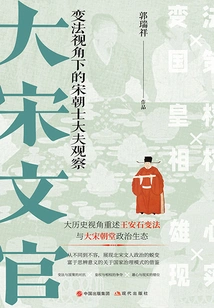
Civil Service Officials of the Song Dynasty: Observations on Scholar-officials of the Song Dynasty from the Perspective of Reform
by Guo Ruixiang
About This Novel
Renzong died, his heir succeeded to the throne, and the national treasury was insufficient. Xixia was ready to move. Internal and external conflicts became apparent again. The national policies of Zhao and Song Dynasties that had been implemented for nearly a century were facing adjustments. Song Shenzong was an emperor who wanted to make great achievements, and boldly asked Wang Anshi to carry out reforms. However, this reform was controversial from the beginning, and it also led to the division of the civil service class. Although Wang Anshi and Sima Guang were both capable ministers, they attacked each other due to their different political views, which plunged the government into a quagmire of party disputes and was unable to extricate itself. The loose and tolerant political environment suffered a devastating blow. The entire society underwent a series of profound changes, whose influence lasted until at least the end of the 19th century. This book starts from Renzong's establishment of heirs and ends with Yuanyou's transformation. It uses time as the axis, viewpoints as bones, and historical facts as flesh. It reproduces the turmoil of major historical events such as Xining Reform, Yuanfeng Reform, and Yuanyou's Reform. It reveals the evolution of Song Dynasty civil servants from disparity to intolerance, the transition of Song Dynasty politics from centralization to imperial autocracy, and the transformation of social thoughts from openness and tolerance to restraint and conservatism. This provides readers with ample historical facts and dimensions of thinking to deeply understand the political ecology of the Song Dynasty, the spiritual pattern of scholar-bureaucrats such as Wang Anshi and Sima Guang, and even the political characteristics and trends of the entire imperial society. From the perspective of big history, he also put forward his own insights into the national governance model, talent selection mechanism, human choice in the destiny of the times, etc.
Official Sources
What Readers Think
Rating
Community(0)
Rating
Community(0)