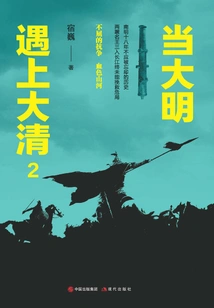
When the Ming Dynasty Met the Qing Dynasty 2
by Su Wei
About This Novel
This book recreates the war between the Ming and Qing Dynasties from 1644 to 1662, tells the little-known historical details, and reveals the truth of the war that has been deliberately hidden. In 1644, with the sacrifice of the governor Sun Chuanting, the Ming army could no longer stop the peasant army from attacking Beijing, and Emperor Chongzhen committed suicide and died for his country. But this does not mean the end of the Ming Dynasty. The real battle has just begun. The opening drama is the Battle of Shanhaiguan. The Qing troops entered the Pass and defeated the peasant army and took control of Beijing. The peasant armies, mainly the Dashun Army and the Daxi Army, were defeated one after another under the pursuit of the Qing army. The war still raged between the Ming and Qing armies. The Ming Dynasty after the migration to the south was historically called the Southern Ming Dynasty. The Hongguang regime in Nanjing, established by the warlords of the four towns in Jiangbei, quickly collapsed under the attack of the Qing army. The subsequent Longwu court in Fujian was established by warlords. With Zheng Zhilong's surrender to the Qing Dynasty, the Longwu regime was also destroyed by the war. Soon, the Yongli court was established in Zhaoqing, Guangdong. Li Dingguo successively won great victories in Guilin and Hengyang. At the same time, the army led by Zheng Chenggong rose rapidly along the coasts of Fujian and Zhejiang. In the Southern Ming Dynasty, two major anti-Qing forces were formed in the southwest and southeast, with Li Dingguo and Zheng Chenggong as the main forces. However, Nanming's biggest failure lies in its inability to unite as one and face the outside world in unison. Li Dingguo became a famous king in two factions, Zhang Mingzhen entered the Yangtze River three times, and Zheng Chenggong resisted the Qing Dynasty in the southeast for more than ten years. In order to save the danger, they tried their best, but due to various reasons, they were unable to form a joint force and always fought independently. In 1662, Nanming ended with a sigh, but left a lot to think about for future generations. Between the decline and the rise, what are the unknown secrets? History is not that simple.
Official Sources
What Readers Think
Rating
Community(0)
Rating
Community(0)