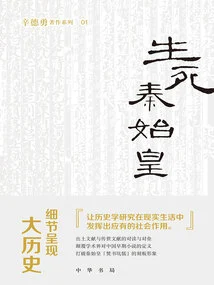
Life and Death of Qin Shihuang
by Xin Deyong
About This Novel
"Zhao Zhengshu", a bamboo book of the Western Han Dynasty, begins with the death of Qin Shihuang and tells the story of Hu Hai's disobedience to Ziying and Li Si's advice, which led to his own death and the country's demise. It has received widespread attention because of its content involving the arrangements for the succession of Emperor Qin Shihuang when he was dying, the legitimacy of the second Emperor Qin's accession to the throne, and even the direct reasons for the overthrow of the Qin Empire. When Professor Xin Deyong read this bamboo book, he took the rise and fall of the Qin Dynasty as the general background and raised a series of questions that ordinary people are not aware of. Does the "Zhao Zheng" in "Zhao Zhengshu" refer to Qin Shihuang? "Zhao Zheng", "Zhao Zheng", "Qin Zheng", "Qin Zheng", "Ying Zheng", "First Emperor"... Which one was the name he used when he was alive? Why is it said that the title of the book "Zhao Zhengshu" (or the title of the chapter) is somewhat unrealistic? What is its origin and what are its characteristics? Although they clearly record the same historical event, why is it different between "Zhao Zhengshu" and "Historical Records"? Which of the two is more trustworthy? Did Qin Shihuang, who was infamous for his "burning books and entrapping Confucianism" throughout the ages, really hate all Confucian scholars and Confucianism in the world? And to some extent, the famous eunuch Zhao Gao, who determined the fate of the Qin Dynasty, was a "castrated person"?
Official Sources
What Readers Think
Rating
Community(0)
Official(1)Scraped 2mo ago
Just take a look. Most of them are better off not believing it.
The author's opinions are individual cases, some of which are credible and some of which can only be determined by looking at them. And as a popular science book, the author has a huge shortcoming. That's when he crossed the line. As a figure in history who should be viewed dialectically, Qin Shihuang's tone was full of disdain, and he directly used words like "idiot" and "**". This violates the basic ethics of popular science and makes his writing even more untrustworthy. These sentences contain strong emotional catharsis and can easily mislead readers. Such behavior is not personal and completely unreasonable. As a serious scholar, how did he write such a work? I can't comment. Not even the most basic respect for historical figures. The introduction of this book is not as good as that of Emperor Wu of the Han Dynasty. It does not mention the author's views and it is a case study. It can open your eyes, but it is not necessary to believe it. In the end, although this book is terrible, the previous judgments about Zhao Zhengshu's value and genre are still valuable.
Rating
Community(0)
Official(1)Scraped 2mo ago
Just take a look. Most of them are better off not believing it.
The author's opinions are individual cases, some of which are credible and some of which can only be determined by looking at them. And as a popular science book, the author has a huge shortcoming. That's when he crossed the line. As a figure in history who should be viewed dialectically, Qin Shihuang's tone was full of disdain, and he directly used words like "idiot" and "**". This violates the basic ethics of popular science and makes his writing even more untrustworthy. These sentences contain strong emotional catharsis and can easily mislead readers. Such behavior is not personal and completely unreasonable. As a serious scholar, how did he write such a work? I can't comment. Not even the most basic respect for historical figures. The introduction of this book is not as good as that of Emperor Wu of the Han Dynasty. It does not mention the author's views and it is a case study. It can open your eyes, but it is not necessary to believe it. In the end, although this book is terrible, the previous judgments about Zhao Zhengshu's value and genre are still valuable.