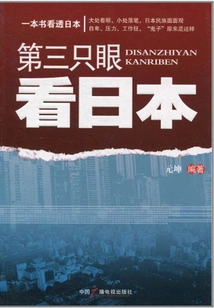
The Third Eye Looks at Japan
by Yuan Kun
About This Novel
See Japan through in one book. Think big and write small, looking at all aspects of the Japanese nation. The inferiority complex of Japan's isolated nation, the arrogance of militaristic Japan, and the pressure of Japan as an economic power are traced back to their origins, revealed in detail, and penetrated into the inner world of the Japanese to present readers with a panoramic view of the Japanese nation and society.
Official Sources
What Readers Think
Rating
Community(0)
Official(3)Scraped 16d ago
There is something wrong with the author's views
The author is very fond of Japan and praises Japan as the supreme nation, as if Japan is the only nation in the world that is the best. Its advantages are greatly magnified, and China's shortcomings are also obviously magnified and compared. When it comes to Japan's bad qualities, they are often brushed over without further development and comparison. The author's position is wrong, his vision is extremely low, and he lacks common sense. The sentence that China calls the police "public security" shows how outrageous and ridiculous the author's most basic common sense is. All in all, the author's position is problematic, he tries his best to whitewash Japan, and his tendency to flatter Japan is extremely serious.
The soldiers in Osaka will inevitably be poisoned by militarism, but Osaka people are obviously more secular than people in other parts of Japan. They still have their own understanding of the slogan "Die for the Emperor, die for the Empire of Japan". In one sentence: "If you can't die, try not to die!"
Books help us understand Japan
The Japanese education for children in the book is well written. The hatred towards Japan may seem ordinary and nothing new. Due to the author's perspective, experience and age, it is difficult to understand the new Chinese people's views on Japan. This is why the book cannot shock people!
Rating
Community(0)
Official(3)Scraped 16d ago
There is something wrong with the author's views
The author is very fond of Japan and praises Japan as the supreme nation, as if Japan is the only nation in the world that is the best. Its advantages are greatly magnified, and China's shortcomings are also obviously magnified and compared. When it comes to Japan's bad qualities, they are often brushed over without further development and comparison. The author's position is wrong, his vision is extremely low, and he lacks common sense. The sentence that China calls the police "public security" shows how outrageous and ridiculous the author's most basic common sense is. All in all, the author's position is problematic, he tries his best to whitewash Japan, and his tendency to flatter Japan is extremely serious.
The soldiers in Osaka will inevitably be poisoned by militarism, but Osaka people are obviously more secular than people in other parts of Japan. They still have their own understanding of the slogan "Die for the Emperor, die for the Empire of Japan". In one sentence: "If you can't die, try not to die!"
Books help us understand Japan
The Japanese education for children in the book is well written. The hatred towards Japan may seem ordinary and nothing new. Due to the author's perspective, experience and age, it is difficult to understand the new Chinese people's views on Japan. This is why the book cannot shock people!