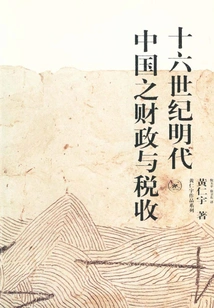
Finance and Taxation in Ming Dynasty China in the Sixteenth Century (hardcover Edition)
by Huang Renyu
About This Novel
The English version of this book was first published in 1974 and is one of Mr. Huang Renyu's representative works. Based on historical materials such as "Records of the Ming Dynasty", "Memories of the Ming Dynasty", "Local Chronicles of the Ming Dynasty" and other historical materials, and fully absorbing the research results of mainland China, Taiwan, Europe, the United States, and Japan, Mr. Huang Renyu conducted a detailed analysis of the finance and taxation of the Ming Dynasty in China in the 16th century, and put forward many valuable viewpoints.
Official Sources
What Readers Think
Rating
Community(0)
Official(5)Scraped 2mo ago
I have always been interested in this part of the content
After research, the author found that regional differences during the Ming Dynasty also had an impact on different economies. Some places were prosperous because of this, while some were poor areas.
The Ming Dynasty was the beginning of seclusion, and a series of consequences of seclusion are self-evident, but overseas trade was even more important.
Financial issues are indeed worthy of study. As the author said, he has also become very interested in this. The financial issues of the Ming Dynasty are also related to some unexplainable issues.
The pros and cons of the American academic approach to historical research
Pros: An in-depth analysis of the finance and taxation of the Ming Dynasty in the late feudal society of China from a new perspective (big historical perspective) without baggage (non-Chinese tradition), which to a certain extent explains the backwardness and irreversible decline of Chinese society after the middle of the Ming Dynasty. Disadvantages: excessively criticizing the ability of feudal rulers from a God's perspective, ignoring the limitations of the times and classes, failing to conduct research in accordance with Marxist historical materialism, and ignoring the objective law that "the economic base determines the superstructure." From the perspective of American democracy, it denies the necessity of centralization and exaggerates the drawbacks of authoritarian centralization. To sum up, readers need to absorb its essence and discard its dross. Although, this book is still an excellent work in the study of Ming history.
Rating
Community(0)
Official(5)Scraped 2mo ago
I have always been interested in this part of the content
After research, the author found that regional differences during the Ming Dynasty also had an impact on different economies. Some places were prosperous because of this, while some were poor areas.
The Ming Dynasty was the beginning of seclusion, and a series of consequences of seclusion are self-evident, but overseas trade was even more important.
Financial issues are indeed worthy of study. As the author said, he has also become very interested in this. The financial issues of the Ming Dynasty are also related to some unexplainable issues.
The pros and cons of the American academic approach to historical research
Pros: An in-depth analysis of the finance and taxation of the Ming Dynasty in the late feudal society of China from a new perspective (big historical perspective) without baggage (non-Chinese tradition), which to a certain extent explains the backwardness and irreversible decline of Chinese society after the middle of the Ming Dynasty. Disadvantages: excessively criticizing the ability of feudal rulers from a God's perspective, ignoring the limitations of the times and classes, failing to conduct research in accordance with Marxist historical materialism, and ignoring the objective law that "the economic base determines the superstructure." From the perspective of American democracy, it denies the necessity of centralization and exaggerates the drawbacks of authoritarian centralization. To sum up, readers need to absorb its essence and discard its dross. Although, this book is still an excellent work in the study of Ming history.