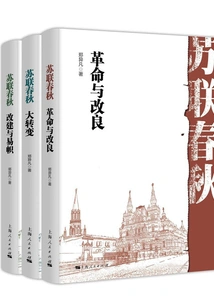
The Spring and Autumn Period of the Soviet Union (three Volumes)
by Zheng Yifan
About This Novel
"Soviet Spring and Autumn" is divided into three volumes, "Soviet Spring and Autumn. Revolution and Reform", "Soviet Spring and Autumn. Great Transformation" and "Soviet Spring and Autumn. Reconstruction and Change of Flags". The first volume "Revolution and Reform", from the Russian February Revolution to before Stalin came to power, mainly explains the revolution before the establishment of the Soviet Union and the social reforms after its establishment; the second volume "The Great Transformation" mainly introduces the history of the Soviet Union during Stalin's rule; the third volume "Reconstruction and Change of Flags" mainly discusses the experience and lessons of the Soviet Union before and after the disintegration.
Official Sources
What Readers Think
Rating
Community(0)
Official(1)Scraped 2mo ago
This book is a collection of research articles on the Soviet Union and Russian issues.
Through the narration of various articles in this book, readers can have a better understanding of the history of the Soviet Union. After reading this book, I was deeply impressed by the Soviet leaders' lack of understanding of their country's national conditions from the early days. I always felt that the Soviet leaders never really based their country's national conditions on formulating national policies, and actually lacked real care and respect for the people. This also laid the foundation for the disintegration of the country. Personally, I think the shortcomings of this book are, first of all, because it is a collection of articles, so it feels fragmented; secondly, there are no special articles in this book to discuss the economic policies of Soviet leaders after Stalin. The author believes that Soviet leaders after Stalin only made minor repairs under the Stalin model, and their economic policies could not fundamentally break through the Stalin model. Stalin model, but in fact it is still necessary to describe the economic policies of Soviet leaders after Stalin. It is definitely different from before and cannot be brushed off lightly. Thirdly, some of the author's views and opinions are questionable. For example, he repeatedly believes that the Stalin model is a continuation of wartime communism. The relevant views have been written along with the ideas in the book and will not be discussed again. Overall, this book is still worth recommending to authors interested in understanding the history of the Soviet Union.
Rating
Community(0)
Official(1)Scraped 2mo ago
This book is a collection of research articles on the Soviet Union and Russian issues.
Through the narration of various articles in this book, readers can have a better understanding of the history of the Soviet Union. After reading this book, I was deeply impressed by the Soviet leaders' lack of understanding of their country's national conditions from the early days. I always felt that the Soviet leaders never really based their country's national conditions on formulating national policies, and actually lacked real care and respect for the people. This also laid the foundation for the disintegration of the country. Personally, I think the shortcomings of this book are, first of all, because it is a collection of articles, so it feels fragmented; secondly, there are no special articles in this book to discuss the economic policies of Soviet leaders after Stalin. The author believes that Soviet leaders after Stalin only made minor repairs under the Stalin model, and their economic policies could not fundamentally break through the Stalin model. Stalin model, but in fact it is still necessary to describe the economic policies of Soviet leaders after Stalin. It is definitely different from before and cannot be brushed off lightly. Thirdly, some of the author's views and opinions are questionable. For example, he repeatedly believes that the Stalin model is a continuation of wartime communism. The relevant views have been written along with the ideas in the book and will not be discussed again. Overall, this book is still worth recommending to authors interested in understanding the history of the Soviet Union.