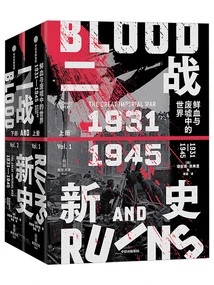
A New History of World War Ii: a World in Blood and Ruin (1931-1945)
About This Novel
On September 18, 1931, Japan caused the September 18th Incident and began to invade Northeast China. This was not only the starting point of the Chinese People's War of Resistance Against Japan, but also the prelude to a new world war. In 1935, Italy invaded Ethiopia. In 1936, Germany entered the Rhineland Demilitarized Zone. In 1939, Germany invaded Poland, and Britain and France declared war on Germany. Subsequently, the Soviet Union and the United States were also involved in the war one after another, and the war spread to remote areas such as the Aleutian Islands in the North Pacific and Madagascar in the southern Indian Ocean. The war required mobilization. More than 100 million people around the world were mobilized to join the army, and on the home front, even more people were mobilized to become workers in arsenals, rescuers in the civil defense system, and guerrillas behind enemy lines. The war did not end until September 1945. The three great empires of Germany, Italy and Japan were buried. The attempts of Britain, France and other countries to rebuild their empires also failed. National liberation movements in Asia, Africa and Latin America were in full swing. Amid the blood and ruins, the Western colonial order that had dominated the world for more than 500 years finally collapsed. Modern nation-states such as China and India emerged one after another. The world order has been greatly changed.
Official Sources
What Readers Think
Rating
Community(0)
Official(1)Scraped 29d ago
Because we cherish peace, we look back on war
This book is different from the traditional history of World War II and has the following characteristics: 1. This book looks at World War I and World War II together, and also touches on the changes in the world political structure after World War II. This way, the causes and consequences of World War II are described more clearly, and the "big historical perspective" is highlighted. 2. This book highlights an equal narrative on each battlefield of World War II, especially acknowledging that the Chinese battlefield was the beginning of World War II, and prominently narrating the atrocities of the Japanese army in the Chinese battlefield, which is very rare in the West. 3. The psychological impact and harm of war on ordinary soldiers and civilians is the key narrative part of this book, which serves the purpose of learning from the past and drawing lessons from the present. In addition, the focus of this book is not on the political and military aspects described in traditional history, but more on the economy, the people, and ordinary soldiers. The perspective is relatively unique and novel. This book leaves readers with a lot to think about, mainly including: 1. Are people innocent in the war? My answer is that it depends on the nature of the war. The people of the country that launched the aggression cannot be said to be innocent. The people of the country that was invaded are obviously innocent. 2. At least from this book, it is difficult for Western countries to say that they played a just role in World War II. The definition of World War II as an anti-fascist war, I personally think, can only be applied to a few countries such as China and Russia. 3. Judging from the narrative in this book, the risk of people being involved in the war was already very high during World War II, so I can't imagine where people could hide once a war breaks out in today's society. Cherishing peace and opposing war are probably not empty words. Even the most selfish people cannot risk their lives.
Rating
Community(0)
Official(1)Scraped 29d ago
Because we cherish peace, we look back on war
This book is different from the traditional history of World War II and has the following characteristics: 1. This book looks at World War I and World War II together, and also touches on the changes in the world political structure after World War II. This way, the causes and consequences of World War II are described more clearly, and the "big historical perspective" is highlighted. 2. This book highlights an equal narrative on each battlefield of World War II, especially acknowledging that the Chinese battlefield was the beginning of World War II, and prominently narrating the atrocities of the Japanese army in the Chinese battlefield, which is very rare in the West. 3. The psychological impact and harm of war on ordinary soldiers and civilians is the key narrative part of this book, which serves the purpose of learning from the past and drawing lessons from the present. In addition, the focus of this book is not on the political and military aspects described in traditional history, but more on the economy, the people, and ordinary soldiers. The perspective is relatively unique and novel. This book leaves readers with a lot to think about, mainly including: 1. Are people innocent in the war? My answer is that it depends on the nature of the war. The people of the country that launched the aggression cannot be said to be innocent. The people of the country that was invaded are obviously innocent. 2. At least from this book, it is difficult for Western countries to say that they played a just role in World War II. The definition of World War II as an anti-fascist war, I personally think, can only be applied to a few countries such as China and Russia. 3. Judging from the narrative in this book, the risk of people being involved in the war was already very high during World War II, so I can't imagine where people could hide once a war breaks out in today's society. Cherishing peace and opposing war are probably not empty words. Even the most selfish people cannot risk their lives.